
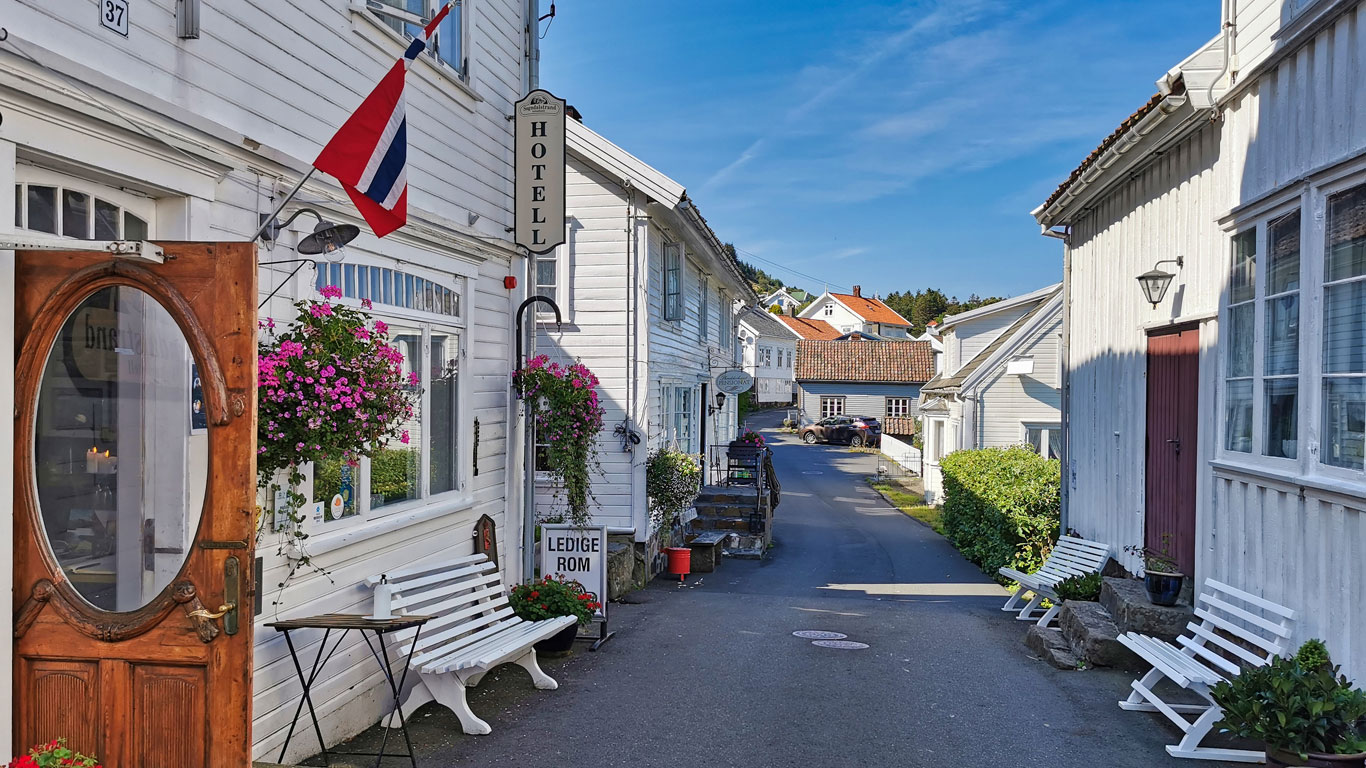
Sogndalstrand grew up as a trading and fishing post where the river Sokna meets the sea. Its wooden houses and boathouses date mostly from the 1700s and 1800s, and because the village was bypassed by later development, it has kept its old shape almost completely. Today it is a protected cultural environment — one of the best-preserved coastal villages in Norway.
Walking through takes only a few minutes, but this is a place to slow down. Look at the details of the old buildings, sit by the harbour, and have lunch or a coffee in the village. Several of the historic buildings now house a hotel, a restaurant and small galleries.
A short drive west, the road drops into Jøssingfjord, a narrow fjord between steep rock walls. Here two old houses stand completely sheltered beneath a huge overhanging rock at Helleren — one of the most unusual sights in southern Norway. The fjord is also known for the Altmark incident in February 1940, an event in the run-up to the German invasion of Norway. Read our Jøssingfjord guide.
We usually combine Sogndalstrand with Jøssingfjord and Helleren, the border village of Åna-Sira, and — for those who want to hike — the cliff caves at Brufjell.
Sogndalstrand, Jøssingfjord and Åna-Sira from Stavanger, with or without the Brufjell hike.
Send a request